

Have you ever wondered if the soft glow from faraway space might be sharing little secrets about our universe? It’s like the gentle twinkle of starlight reaching out to us, inviting us to learn about hidden wonders among stars and nebulae.
This light comes from amazing events, such as the lingering warmth of the Big Bang and the swirling disks of black holes. Think of it as a quiet messenger, carrying clues about the secrets of the cosmos.
In this post, we’re going to chat about what cosmic light really is, where it comes from, and how it helps us understand the nature of our universe.
Understanding Cosmic Light: Nature, Origins, and Importance
Cosmic light is like the gentle glow of the universe, shining in all sorts of waves, from the slow, deep rhythm of radio waves to the quick, energetic dance of gamma rays. Imagine a soft light drifting in from the far corners of space, carrying little secrets of a cosmic clock that lets us witness events from far-off stars and galaxies.
This light isn’t just what we see with our eyes. It covers a vast spectrum, almost like a cosmic rainbow where each part, whether radio or ultraviolet, tells its own story about the universe. Scientists compare these different bands to understand how nature works in every corner of space.
Most of this light springs from stars, the beautiful, bubbling clouds of nebulae, and even the quiet afterglow of the Big Bang. Stars shine brightly as they mix elements in a fusion dance that lights up the dark. And don’t forget those swirling disks around black holes, which send out bursts of energy that travel far and wide. These sources not only show us the beauty above but also explain the natural processes that keep our sky alive.
Physical Properties of Cosmic Light: Spectra, Wavelengths, and Emission
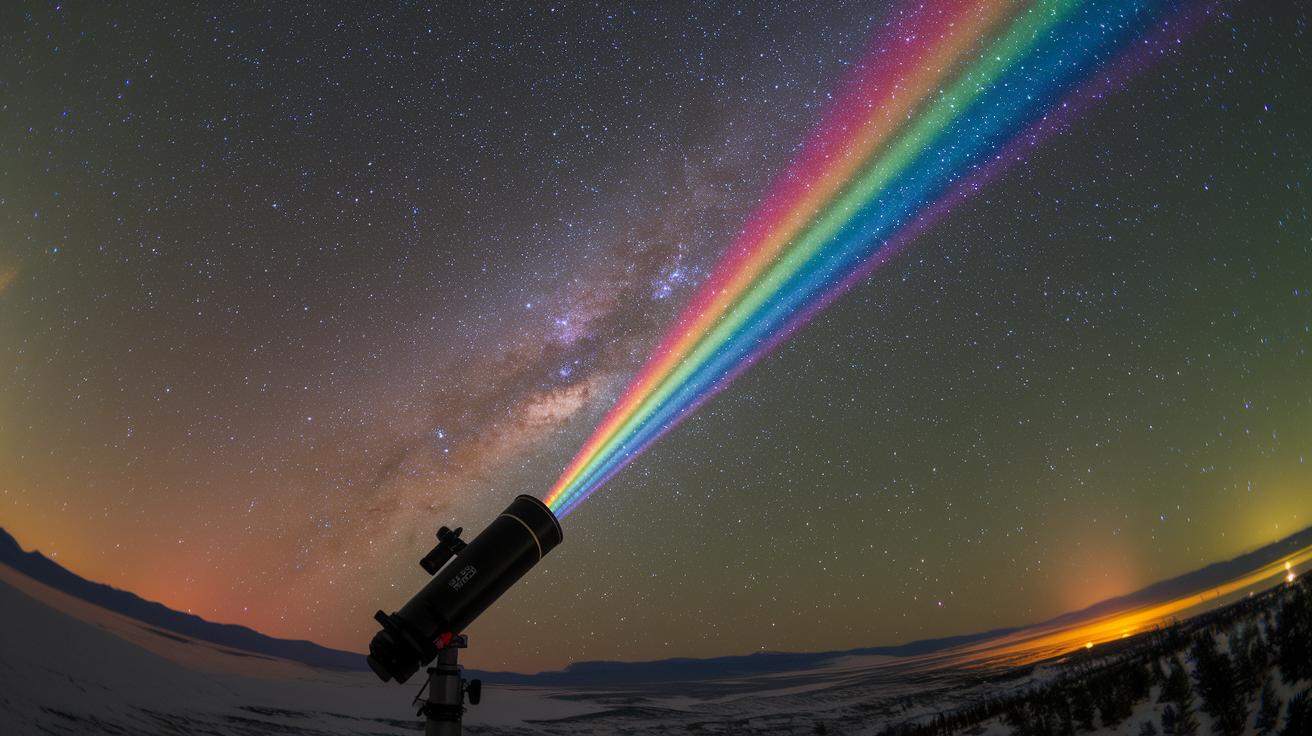
Imagine cosmic light as a secret message from the stars. When we break light into its rainbow of colors and wavelengths, we get a peek at the hidden stories of stars, nebulae, and even the echo of the Big Bang. It tells us about the warmth, makeup, and movement of distant wonders. Think of it as a secret key that slowly unlocks the mysteries of the universe, one wave at a time.
Spectral Range and Wavelengths
Cosmic light stretches across an amazing range. It begins with deep radio waves that can be as long as 1000 meters, then moves into the warm glow of infrared and visible light, that friendly band between 400 and 700 nanometers. From there, it speeds into ultraviolet territory and even faster X-rays and tiny gamma rays that pack a lot of energy with wavelengths shorter than 10^-12 meters. Even the soft background hum of the cosmos, the cosmic microwave background, peaks around 160 GHz, which is about 1.9 millimeters. All the while, clouds of cosmic dust and gas gently absorb and scatter these wavelengths, changing the light ever so slightly as it journeys through space.
Emission Lines and Energy Distribution
Sometimes, certain wavelengths in cosmic light shine with extra brilliance. For instance, hydrogen alpha gives off a clear glow near 656.3 nanometers, while doubly ionized oxygen lights up the sky with a green glow around 500.7 nanometers. These bright spots act like markers in a night sky, guiding scientists to where the light comes from and what conditions are at play. When cosmic rays and particles mix with clouds of gas and dust, some wavelengths get absorbed and others shine through, crafting a beautiful pattern. This pattern reveals details about energy levels and conditions in far-off regions, a graceful balance between raw cosmic power and the influence of its surroundings.
Observational Techniques for Cosmic Light
The universe shows us a rainbow of secrets that our eyes just can’t see. Scientists use tools that capture everything from radio waves to X-rays to reveal cosmic mysteries. They rely on methods like CCD imaging, which takes pictures of starlight, interferometry that combines signals from many telescopes for sharper images, and polarimetry that reads the way light waves line up. Ever wonder how the universe shares its hidden story? Next week, NASA’s IXPE mission will do just that. It uses X-ray polarimetry to explore the magnetic tunes of black holes and neutron stars. Principal Investigator Martin Weisskopf says these results let us peek into how jets form around these mysterious objects.
| Instrument | Type | Wavelength Range | Primary Objective |
|---|---|---|---|
| Hubble Space Telescope | Optical | Visible light | Capture detailed images of distant galaxies |
| Very Large Array | Radio | Radio waves | Study radio emissions from celestial sources |
| ALMA | Millimeter | Millimeter wavelengths | Probe cold universe components like dust and gas |
| IXPE | X-ray | X-rays | Measure polarization patterns to reveal magnetic field alignment |
By weaving together tools like polarimetry and interferometry, scientists get a fuller picture of cosmic light. Polarimetry shows us how light is arranged when it bursts from energetic spots, while interferometry blends signals to create clearer images. These approaches work hand-in-hand to reveal how matter, light, and magnetic fields interact. In truth, this cosmic teamwork is what helps unlock the secrets of our universe, sparking a deep curiosity as we continue our journey among the stars.
Cosmic Radiation and Deep Space Light Phenomena

Cosmic rays are like tiny, speedy messengers from deep space. They start as neutral atoms that lose their outer layers and become charged particles. Imagine them whizzing by at nearly the speed of light and being tossed around by invisible magnetic forces. Trying to trace their origins is a bit like trying to catch a whisper in a noisy room.
Back in the 1700s, curious minds noticed strange electrical sparks during experiments, hinting that high-energy particles were visiting us from space. This mystery got early researchers scratching their heads and sparked new ways to learn more. Before long, scientists set up ground detectors and learned to watch for showers of secondary particles in our atmosphere. These clever tricks helped them measure cosmic ray energies and piece together clues about how these particles get such a powerful kick. The University of Chicago played a big part in these early breakthroughs, laying the groundwork for what we know today.
More recently, efforts to sharpen our cosmic radar have ramped up. NASA handed out $4.3 million to wrap up building advanced facilities that promise even finer measurements. These new tools will help us dive deeper into how cosmic rays interact with the vast space between stars. With steady funding and a passion for discovery, researchers are keeping the quest alive, ever eager to unlock more secrets of our energetic universe.
Cosmic Light Sparks Astrophysical Curiosity
General relativity tells us that light gently curves when it passes near big, heavy objects like galaxies and black holes. It’s sort of like watching a river smoothly flow around a large rock. This bending, known as gravitational lensing, lets us peek into hidden parts of the universe. And when light coming from far-off galaxies turns redder, a sign called redshift, it shows us that the universe is constantly growing. Imagine a beam of light dancing around a massive star, guided by gravity. This beautiful twist in the path of light gives scientists clear proof that gravity shapes even the tiniest spark of light.
Photons, the little particles of light, often journey through clouds of dust and gas on their way to us. Along the way, they can lose some energy and get scattered, which changes their brightness and hue. These small changes act like clues, whispering secrets about the space they travel through. Researchers study these soft shifts in light to fine-tune their models of the universe. Even the tiny variations seen in cosmic microwave background images hint at early photon adventures, offering a simple snapshot of the universe shortly after the Big Bang.
Spiritual and Cultural Perspectives on Cosmic Light

Cosmic glow has captivated countless hearts, inviting us to seek that inner light found in the vastness above. For ages, people have seen the gentle shimmer of stars as a sign of enlightenment and a friendly call to connect with something larger than daily life. It’s like the night sky is softly whispering secrets about our inner worlds and the mysteries of nature.
Think about it this way: ancient cultures turned to the soft sparkle of starlight in ways that still inspire us today. Here are a few examples:
- Vedic starlight meditation – a time-honored practice where the twinkling stars help still your mind and spirit. For more about these calming methods, check out the link on cosmic guidance and how it works.
- Egyptian temple alignments – grand structures crafted to catch the glow of far-off stars, honoring ancient gods by arranging sacred spaces to mirror the sky.
- Indigenous Australian celestial narratives – enchanting stories and songlines where cosmic light guides traditions and weaves communities together.
- Modern guided visualizations – today, many use the serene picture of cosmic light in meditation to find calm and focus. Discover more on understanding cosmic signals and universal synchronicity.
Even now, the light from above continues to spark our imagination. Whether you’re meditating under a starry sky or joining a cultural ritual, that soft glow reminds us to look for beauty, clarity, and gentle change in our lives.
Recent Research and Future Directions in Cosmic Light Studies
Scientists have been buzzing with excitement over some incredible discoveries in the gentle glow of outer space. The James Webb Space Telescope recently shared its first images, giving us a rare glimpse into how early galaxies formed. These pictures show the soft, newborn light of young galaxies, offering hints on how the brightness of our cosmic home has changed over billions of years.
Recent surveys have also uncovered surprising magnetic filament structures within galaxy clusters. Think of these findings like pieces of a vast cosmic puzzle that help us understand the delicate interplay of forces shaping our universe. It's like the stars are sharing their secrets one by one.
And now, future missions are set to take our cosmic vision even further. The upcoming LUVOIR mission will map the ultraviolet glow across large stretches of space. This project may seem small, but it promises to reveal the hidden outlines of early stars and galaxies, much like uncovering a secret treasure map in the night sky.
New computer models and visualization tools are also changing the way we see cosmic light. These models simulate brightness patterns stretching back 13.8 billion years, telling a continuous story from the Big Bang until now. Meanwhile, advanced planetarium systems use adaptive optics to create immersive displays that make you feel as if you are surrounded by the soft vibrance of space. Imagine sitting in a dark room as a gentle cascade of starry light unfolds around you, capturing how distant stars and nebulae dance in a beautiful cosmic ballet.
Final Words
In the action, we unraveled how cosmic light flows from stars, nebulae, and even the Big Bang's gentle glow. We touched on its vivid physical clues, learned about the tools that let us see this gentle radiance, and even peeked at its symbolic whispers in ancient and modern practice.
This article leaves us with a warm sense of clarity. The spark of cosmic light reminds us that every day carries hints of wonder and bright opportunities.
FAQ
Q: What is cosmic light and what does it mean?
A: Cosmic light means the radiant energy emitted by stars, nebulae, and the residual glow from the Big Bang. It is part of the electromagnetic spectrum we see everyday.
Q: What is cosmic energy and is it real?
A: Cosmic energy refers to the energetic processes powering stars and galaxies. While scientists study its physical aspects, some also interpret it as a subtle force felt in personal well-being.
Q: What does cosmic light euthanasia mean?
A: Cosmic light euthanasia is not a recognized scientific term. It may be a mistaken or symbolic phrase rather than one rooted in astrophysical research or medical practice.
Q: What is meant by Cosmic Light vet?
A: Cosmic Light vet is not an established concept in astronomy. It might refer to a themed veterinary service or brand name rather than a term related to cosmic science.
Q: What is a cosmic light projector?
A: A cosmic light projector is a device designed to display images of starry skies and celestial patterns. It brings the gentle glow of space into your living space.
Q: What could a cosmic light crossword clue refer to?
A: A cosmic light crossword clue likely hints at terms like starlight or radiation. It requires finding a word that captures the idea of illumination from celestial sources.
Q: What are cosmic rays and how do they affect humans?
A: Cosmic rays are high-speed particles from space that strike Earth’s atmosphere. They affect humans minimally, as our atmosphere largely shields us from their direct impact.
Q: What does cosmic lightning refer to?
A: Cosmic lightning describes brilliant, high-energy flashes seen during energetic cosmic events. It poetically captures the dazzling bursts that occur in deep space phenomena.