

Have you ever wondered how far-off planets shape the space around us? Imagine them as cosmic guardians with a quiet strength that forms invisible circles. They pull in wandering asteroids and guide tiny space rocks along their paths.
Their gravity turns the wild chaos of space into a calm, balanced rhythm. In this post, we'll explore how these distant giants gently steer other planets and objects, creating a graceful dance of cosmic wonder.
Gravitational Influence of Outer Planets on Solar System Dynamics

Imagine the far-off giants of our solar system. These outer planets have mighty gravitational fields that stretch well beyond their orbits. They each have a special bubble, called a Hill sphere, where a planet's pull wins over the Sun’s. In simple terms, the heavier the planet or the farther it is from the Sun, the bigger its bubble. It’s like having a warm, protective glow that keeps neighboring objects in line.
Scientists mix a planet’s mass with its distance from the Sun to figure out how far its gravitational reach extends. This simple calculation helps us picture how these bubbles interact with asteroid belts and icy bodies way past Neptune. When the bubbles overlap, it creates gentle pushes and pulls between different planets, nudging little space rocks along their paths and making sure the orbits all stay in balance.
| Planet | Mass (kg) | Semi-major Axis (au) | Hill Radius (au) |
|---|---|---|---|
| Jupiter | 1.898×10^27 | 5.2 | 0.355 |
| Saturn | 5.683×10^26 | 9.58 | 0.428 |
| Uranus | 8.681×10^25 | 19.2 | 0.45 |
| Neptune | 1.024×10^26 | 30.05 | 0.77 |
When these gravitational bubbles touch, their combined pull can gently steer asteroids or clear small objects from busy space. This cosmic dance not only influences the outer realms but also keeps the orbits of the inner planets smooth and steady over time. In short, the outer planets, with their heft and well-placed positions, help maintain a balanced solar system where every orbit is guided by a soft, unseen pull.
Outer Planetary Shields: Jupiter and Saturn’s Protective Roles
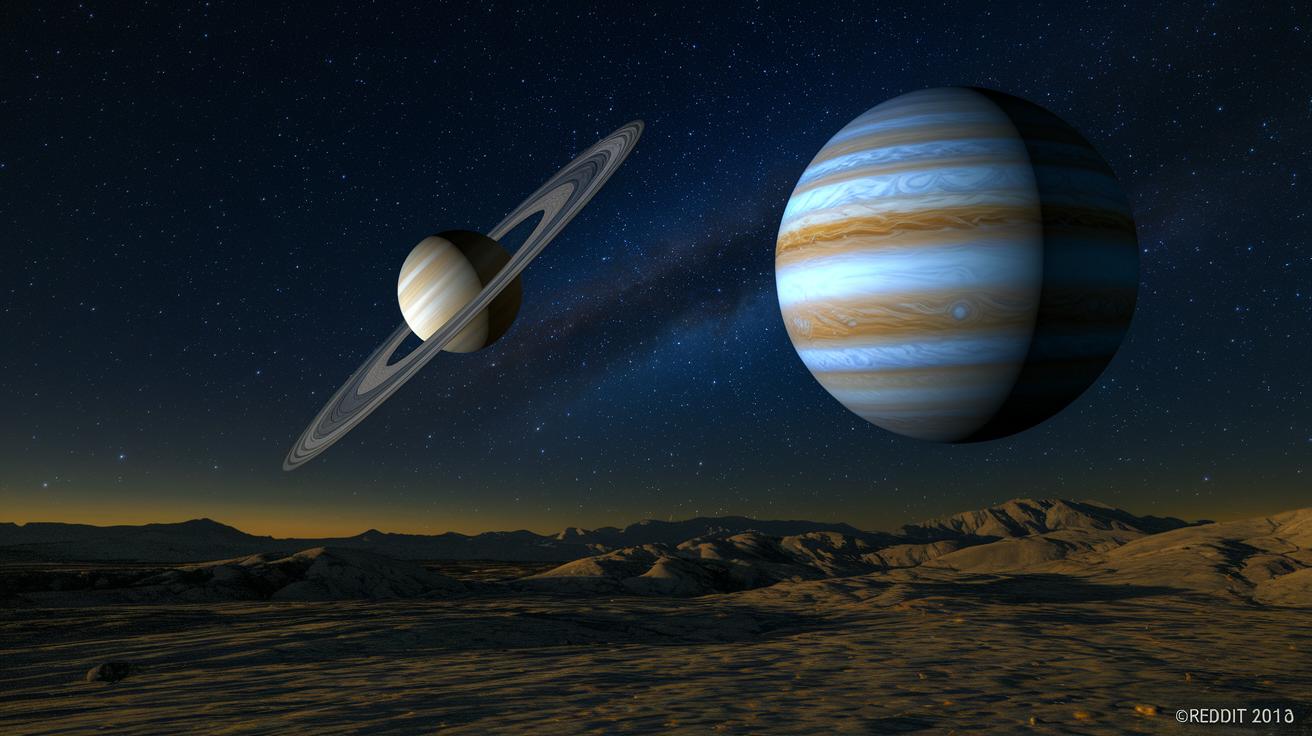
Jupiter and Saturn are like cosmic bodyguards for our inner planets. Jupiter, with its huge mass, nudges about 95% of comets coming from the distant Oort cloud off course. Imagine it as a gentle giant using its gravity to send dangerous space rocks away from Earth. Saturn also plays a big part by catching or shifting many short-period comets into safer paths. Think of Saturn as a friendly guide, gently steering these objects so they don’t pose a threat.
Models and computer simulations show that Jupiter’s strong pull cuts potential Earth impacts by ten times over 4 billion years. Saturn helps out too by trapping or rerouting risky objects into secure orbits. Together, these two planets create a hand-in-hand shield that gently guides hazardous comets and asteroids away from the inner solar system. Their teamwork keeps our cosmic neighborhood calm and stable, much like a protective safety net under the starlit sky.
Resonant Orbital Mechanics Shaped by Giant Masses
Imagine a cosmic heartbeat where orbiting bodies fall into a perfect rhythm. Mean-motion resonances happen when these celestial objects line up in a regular pattern, like dancers moving in sync under the gentle glow of starlight. It’s all guided by gravity, creating neat groups and tidy gaps among clusters of space rocks.
Think of Jupiter’s 3:2 resonance as a kind of cosmic guardian that keeps the Hilda asteroids gently circling around 4.0 au in a balanced and predictable way. Meanwhile, Jupiter’s 2:1 resonance clears out a region near 3.27 au, carving a space that stays clean and orderly a bit like tidying up your room.
Then there’s the classic Neptune-Pluto 3:2 resonance. It locks Pluto into a secure orbital pattern, allowing it to glide along its long, winding path as if it were dancing to its own comforting tune. Saturn and its moon Mimas work together in a 2:1 resonance that creates the famous Cassini Division in Saturn’s rings, imagine a delicate gap where stardust is gently nudged aside.
Over at Uranus, interactions with the moon Miranda cause small moons to gently tilt their orbits, a subtle reminder of how even small nudges in space can lead to beautiful, graceful changes.
All of these resonances work like invisible scaffolding that shapes where and how orbits are spaced. They hold belts and rings in delicate order and help keep the solar system stable in the long run. Every orbit plays its unique part in this vast symphony of gravity, a cosmic melody that has been playing since the dawn of time.
Migration of Giant Planets and Evolution of System Architecture

About 700 to 800 million years after our solar system was born, everything began to shift in a big way. The Nice model tells us that Jupiter and Saturn got into a gravitational rhythm when they crossed a 1:2 resonance (that’s when their gravitational pulls synced up). This gave Uranus and Neptune a gentle push to slowly drift outward. And then there’s the Grand Tack idea, where Jupiter scooted inward to nearly 1.5 au (a unit of distance similar to the gap between Earth and the Sun) before flipping its course again. Picture it like Jupiter making a graceful U-turn that rearranged the space for smaller rocky planets to eventually take shape.
The resonance crossings acted like a celestial nudge for these orbit changes. The gravitational pull between Jupiter and Saturn during their resonance exchange sent the outer planets on a new journey away from the Sun. It was almost like a perfectly timed domino effect, where each little push set off another, slowly reshaping the entire solar lineup. With every tug, the whole system was fine-tuned, leaving a gentle but lasting mark on how our neighborhood of planets is set up.
As these giant planets wandered, they cleared the cosmic stage. Their movement stirred up and swept away piles of dust and debris within the protoplanetary disk, making room for inner rocky planets to come together more easily. This mighty migration might even have sparked what scientists call the Late Heavy Bombardment – a busy time of collisions that helped carve out and refine the surfaces of the planets we see today.
Long-Term Dynamical Evolution Driven by Outer Planets

Jupiter and Saturn are like gentle cosmic guides. Their strong but steady pull nudges the paths of other bodies, slowly shifting the point where an orbit hugs closest to the sun. This gradual shift happens over hundreds of thousands to millions of years and is called secular perturbation, a fancy term that simply means a slow, steady change in an orbit. Together, these gas giants hold over 90% of our solar system’s motion energy, guiding everything like a subtle cosmic clock ticking in the night.
Uranus and Neptune add a unique twist to this celestial dance through something known as Kozai-Lidov cycles. These cycles can stretch small bodies into long, slender orbits, giving them bursts of energy that shake up their usual paths. Over billions of years, other effects like dynamical friction and chaotic diffusion slowly mix orbital energies. This gradual reshuffling helps keep the inner parts of the solar system calm and balanced, like the soft whisper of starlight in the quiet night.
Modeling Complex Interactions: N-body Simulations of Giant Planets

N-body integrators like Mercury6 and REBOUND are nifty computer programs that let us watch the cosmic dance of giant planets for billions of years. They work by crunching numbers that stand for the push and pull of gravity across many bodies at once. Every simulation needs careful choices, like picking time steps and starting points, to keep things running true over long periods. Even the tiniest misstep can build up and throw off the delicate movement of huge planets and many smaller ones. Thanks to advances in powerful computing, we now catch these resonant locks and scattering events in great detail, giving us a peek into our solar system’s complex puzzle.
Simulations give us amazing insights that connect our own system with distant ones such as HR 8799. They show how giant planets can trigger movements by stirring up nearby objects and sometimes even capturing stray wanderers. Many models hint that shifts in orbits might line up with dramatic events like the Late Heavy Bombardment. This tells us that giant planets play a big role in shaping their systems, setting the layout for smaller bodies and keeping a balance that echoes across the cosmos.
Final Words
In the action, we explored how outer planets shape our solar system. We saw how massive giants create gravitational fields that guide cosmic bodies. Small shifts from Jupiter and Saturn protect inner worlds while resonant forces set precise orbital patterns.
Our analysis connected migration and long-term dynamics, showing the role of outer planets in shaping planetary influences. This cosmic insight lights a path for a renewed, positive outlook towards the mysteries above.
FAQ
What do inner planets represent in astrology?
The inner planets in astrology highlight personal influences like communication, emotion, and actions. They capture the daily energy that shapes our personality and how we interact with the world.
How do personal planets differ from generational planets?
The personal planets reflect individual qualities such as thoughts and feelings, while generational planets like Uranus, Neptune, and Pluto indicate broader, collective trends that influence entire age groups.
What significance do Uranus, Neptune, and Pluto hold in astrology and Vedic astrology?
Uranus, Neptune, and Pluto are viewed as transformative energies in Western astrology, often signaling deep shifts. In Vedic astrology, their roles bring cultural dimensions to predictions and insights.
What do the outer planets represent in astrology?
The outer planets represent energetic forces that mirror long-term cycles and community shifts. They offer clues about transformative periods and broader changes beyond our daily personal experiences.
How do the size and composition of outer planets differ from inner ones?
The outer planets differ by their larger sizes and broader gravitational spheres. Their mass and distance from the sun create cosmic patterns and effects not commonly seen in the inner, more compact planets.
How do planets influence our lives?
The influence of planets on our lives comes through their energetic patterns, which shape our moods, actions, and perspectives. They act like cosmic signals that guide both personal and collective experiences.